"There is more treasure in books than in all the pirate's loot on Treasure Island." - Walt Disney
Monday, July 16, 2012
5 of the Worst Author Traits
1. Bad-Mouthing – Whether it’s the agent, editor, publisher, or publishing in general, this is one trait that can damage a writers career. What most authors don't understand is that the squeaky wheel does not get the grease. A company may only publish 10 books a year, and everyone -- publicist, copywriter, editor -- makes decisions regarding how they are going to spend their time and money. With so many choices, they WILL NOT back someone with a bad, ungracious, or unprofessional attitude.
2. Shyness – Most writers are solitary creatures who struggle with placing themselves at the center of attention. The industry needs an author who is going to be out there acting as an advocate for his/her book both online and in person. A publicist can get reviews for your book if you're not good with strangers, but you still need to be active on listservs, at conventions, and so forth. They want to know you can help sell your product.
3. Arrogance- Authors who talk about themselves incessantly can be a turn off. When pitching an idea, or making industry connections be sure to start with conversation "How are you?", "What are you reading these days?", "Can you give me a sense of what you like and dislike?" etc. It won't hurt to ask them where they live or how many kids they have, instead of just telling them about your manuscript and how fabulous it is.
4. Adversarial or Lying – Editors and agents will walk away from contracts with authors who decide to play hard ball or who outright lie. There are too many good books in the world to deal with such nonsense. Remember, they are signing someone they hope to work with for years if not decades. Why would they want to sign someone who's going to make them miserable for that length of time? And never forget editors, agent, publishers all know each other and talk. So if you burn bridges with one, the word will spread and you could potentially burn ALL bridges.
5. Obligation – Writers mistake obligations. First, you have an obligation to meet all deadlines and any other promises made to your agents, editors, and publishers. If there is a problem doing so, keep in touch with them and let them know what is happening or why BEFORE the deadline, not after. Subsequently, don't mistake a publisher’s obligation. It is NOT to publish everything that's submitted. Just because they published one piece by you does not mean they will automatically publish everything you submit. If anything, they may actually hold writers to HIGHER standard with each subsequent work.
Friday, July 13, 2012
10 Reading Venues Worth a Visit
1. Vancouver Public Library (Vancouver, British Columbia, Canada)
The beginnings of the Vancouver Public Library date back to the beginnings of Vancouver as a whole, back in 1867. This year marked the construction of the area’s first sawmill, the Hastings Mill. Over the years, the area around the Hastings Mills became the location of the Hastings Literary Institute. A Central Library was constructed at 750 Burrard Street. This building, however, became outdated and overcrowded, and eventually led to the creation of the Library Square, a new central library. Architects Moshe Safdie, Richard Archambault and Barry Downs won the design competition for the new library, which was opened in 1995. Today, the Vancouver Public Library, which includes the Library Square, is the third largest public library system in Canada. It has over 373,000 cardholders, who borrow more than 9 million items annually. Vancouver Public Library is accessible to all citizens of Vancouver and moreover, has an extensive virtual library collection. You can find information on visiting the Central Library, including opening hours, here.
2. Royal Danish Library (Copenhagen, Denmark)
The Royal Library in Copenhagen is the largest library in the Nordic countries. It serves both as the national library of Denmark, as well as the university library of the University of Copenhagen. Its collection includes various historical treasures. To be exact, all the books that have been printed in Denmark since the 17th century are archived here. The first Danish book, which dates back to 1482, is also deposited here. In 1906, Hans Jorgen Holm constructed the first building, located at the Slotsholmen site. This building’s central hall is a copy of the Charlemagne’s Palace chaped in the Aachen Cathedral. The newer building (pictured above and located adjacent to the old one) is called the Black Diamond. It was designed by Danish architects by Schmidt hammer lassen. It holds the name of “Black Diamond” because of its outside cover of black marble and glass. In addition, it is worth noting that it contains a concert hall in addition to the library, both of which are open for visits.
3. Austrian National Library (Vienna, Austria)
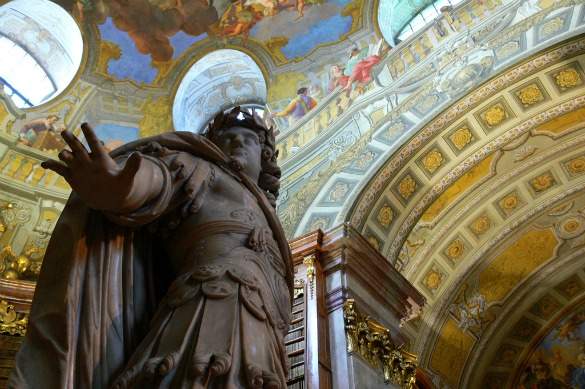
The Austrian National Library is the central academic library of the Republic of Austria, and as such, spans a rich history and tradition that dates back all the way to the 14th century. Its mission is to serve as a “centre of information and research oriented toward serving the public, as an outstanding national memory institution and as a many-side centre of education and culture.” The part especially worth visiting is the Baroque State Hall, which prides itself as being one of the world’s most beautiful historic libraries. It was Emperor Charles VI who ordered it to be constructed as his Court Library. Architect Johann Bernard Fischer von Erlach planned its construction, and it was built from 1723 to 1726 by his son Joseph Emanuel. Court painted Daniel Gran, in turn, can be thanked for the beautiful ceiling frescoes. Admission prices and opening hours of the State Hall are listed here.
4. National Library Singapore (Singapore, Singapore)
The National Library of Singapore dates back to 1823. At that time, it was very much linked to the founding of Singapore’s first major educational institution, The Singapore Institution. Much time has passed since then, and this institution is now known as the Raffles Institution. The National Library, too, has undergone great evolution; at the beginning it only served the needs of a privileged few but nowadays it is aimed at reaching out towards all Singaporeans. The National Library Building houses the Lee Kong Chian Reference Library and the Central Public Library. Opening hours are listed here.
5. Law Library of the University of Zurich (Zurich, Switzerland)
Some libraries are known for the great architects that built them. The Law Library of the University of Zurich is one of them. It carries the famous name of Spanish architect Santiago Calatrava, who has his main office in Zurich. The library was opened in 2004, after 15 years of planning and construction. The original building dates back to 1908, and Calatrava’s extended version cannot actually be seen from the street. The library’s collection itself holds about 170,000 books and 700 magazines.
6. Great Court and Reading Room, British Museum (London, United Kingdom)
If Calatrava is the name associated with the Law Library of the University of Zurich, the architect that made the Great Court famous is Norman Foster. He and his team of architects transformed the British Museum’s inner courtyard into the largest covered public square in Europe. Enclosed by a spectacular glass roof, we find the world-famous Reading Room at its centre. Since the Reading Room is officially part of the Museum, it is open for visits. You can find opening hours and admission prices here.
7. Philological Library of the Free University (Berlin, Germany)
The Philological Library of the Free University in Berlin is another work of Foster and Partners. Since the end of World War II, the Free University has been not only of the city’s symbolically most important institutions, but also one of the leading universities in Germany as a whole. It occupies a central role in the capital’s intellectual life. Its redevelopment, in turn, includes the restoraction of the university’s Modernist buildings and the construction of the new Philology Library, which was built from 1997 to 2005.
8. Lello Bookshop (Porto, Portugal)
A bookshop is not a library per se, but it certainly qualifies as a place where books are stored (and sold). The Lello Bookshop, called Livraria Lello in Portuguese, is notorious for its windy staircase and vibrant pink color. It was built in 1906 by an engineering professor, Xavier Esteves. Packed with old and new books, it provides a wonderful experience for book lovers and architecture aficionados alike.
9. Bibliothèque Nacionale de France (Paris, France)
National libraries are national landmarks. In France, the National Library is located in the capital: Paris. Its origins trace back to the royal library founded at the Louvre by Charles V in 1368. In 1998, the French president Francois Mitterand ordered the construction of a new building, which contains more than ten million volumes. An exhibition space is also part of the new building.
10. Biblioteca Nacional de España (Madrid, Spain)
The National Library of Spain didn’t always carry the name of National Library. It was founded by Felipe V at the end of 1711 and opened its doors in March of 1712 as the “royal public library.” In 1836, it passed from being royal property to belonging to the government, and then, first became known as the National Library of all of Spain. As is the case with the national library in Paris, this building is also an exhibition space and houses temporary exhibitions that are open to all.
Wednesday, July 11, 2012
7 Literary Locations to Visit With Kids
These seven literary locations introduce kids to some classics and may help them find new favorites.

Few kids are aware of Edward Gorey’s work, but they should be. Long before A Series of Unfortunate Events became a phenomena, Gorey wrote and illustrated The Gashleycrumb Tinies, An Appalling Alphabet Which Introduces A Gallery Of Enchanting Tots And Produces A Gasp Of Involuntary Mirth When They Attain Their Dreadful Demise. Creepy and funny, it’s everything kids love most. Gorey’s house is a delightful glimpse into his whimsical, macabre imagination.

Over 100 years since Lucy Maud Montgomery’s Anne of Green Gables came out, the book continues to win new generations of fans around the world. The book is so popular in Japan that the historic site on Montgomery’s old stomping grounds has become a destination wedding site for Japanese couples. Green Gables, home of Montgomery’s relatives, demonstrates what life was like during the times in the Anne books. The site holds a children’s festival every August.

At age 65, Laura Ingalls Wilder started writing the Little House on the Prairie books at Rocky Ridge Farm, the place where she finally settled after many moves in her pioneer youth. The site features many of Wilder’s possessions and photos. You can also visit the Ingalls family dugout site in Walnut Grove, Minnesota, the Ingalls Homestead in De Smet, South Dakota and the Laura Ingalls Wilder Park and Museum in Burr, Iowa, where the family lived after the “Plum Creek” period.

Jack London’s The Call of the Wild, White Fang, and Sea Wolf have all the elements that keep kids turning the pages, even a century after they were written. London’s own life was full of adventure and intrigue, too, and kids can learn about it on the ranch he called home. While many of the buildings are in ruins (and fun to climb on!), the House of the Happy Walls, built by London’s widow, is now a museum that highlights the author’s life. The ranch also includes London’s “pig palace,” hiking trails, and gravesite, making it a perfect afternoon trip that combines history, literature, and the outdoors.

With wax figures of Holmes and Watson and Victorian furnishings, the Sherlock Holmes Museum recreates the fictional world of the famous detective rather than the life of Sir Arthur Conan Doyle, the author who created him. It’s a fun introduction to the books for kids who may not yet be fans.

From Charlie and the Chocolate Factory to James and the Giant Peach to The Witches and Matilda, Roald Dahl’s stories are known around the world and loved fanatically by kids of all ages (and grownups, too). Younger kids especially will love the hands-on activities and walk-in giant peach at the Roald Dahl Museum, and older ones will enjoy learning about their favorite author’s life.

You’d be hard pressed to find a Scandinavian under the age of 50 didn’t grow up reading and loving the Moomin books by Tove Jansson. While they have more of a cult following in the US, the hippo-like family of trolls are huge in Northern Europe and Japan, and are national icons in their native Finland, where they’re celebrated at the literary theme park, Moomin World in Naantali. The Moomin World park features a recreation of the Moomin’s beloved Moomin Valley and roaming costumed characters.
What authors would your kids love to learn more about?
1. The Edward Gorey House, Yarmouthport, Massachusetts
Few kids are aware of Edward Gorey’s work, but they should be. Long before A Series of Unfortunate Events became a phenomena, Gorey wrote and illustrated The Gashleycrumb Tinies, An Appalling Alphabet Which Introduces A Gallery Of Enchanting Tots And Produces A Gasp Of Involuntary Mirth When They Attain Their Dreadful Demise. Creepy and funny, it’s everything kids love most. Gorey’s house is a delightful glimpse into his whimsical, macabre imagination.
2. Green Gables Heritage Place, Cavendish, Prince Edward Island
Over 100 years since Lucy Maud Montgomery’s Anne of Green Gables came out, the book continues to win new generations of fans around the world. The book is so popular in Japan that the historic site on Montgomery’s old stomping grounds has become a destination wedding site for Japanese couples. Green Gables, home of Montgomery’s relatives, demonstrates what life was like during the times in the Anne books. The site holds a children’s festival every August.
3. Laura Ingalls Wilder Historic Home and Museum, Mansfield, Missouri
At age 65, Laura Ingalls Wilder started writing the Little House on the Prairie books at Rocky Ridge Farm, the place where she finally settled after many moves in her pioneer youth. The site features many of Wilder’s possessions and photos. You can also visit the Ingalls family dugout site in Walnut Grove, Minnesota, the Ingalls Homestead in De Smet, South Dakota and the Laura Ingalls Wilder Park and Museum in Burr, Iowa, where the family lived after the “Plum Creek” period.
4. Jack London State Historic Park, Glen Ellen, California
Jack London’s The Call of the Wild, White Fang, and Sea Wolf have all the elements that keep kids turning the pages, even a century after they were written. London’s own life was full of adventure and intrigue, too, and kids can learn about it on the ranch he called home. While many of the buildings are in ruins (and fun to climb on!), the House of the Happy Walls, built by London’s widow, is now a museum that highlights the author’s life. The ranch also includes London’s “pig palace,” hiking trails, and gravesite, making it a perfect afternoon trip that combines history, literature, and the outdoors.
5. The Sherlock Holmes Museum, London, England
With wax figures of Holmes and Watson and Victorian furnishings, the Sherlock Holmes Museum recreates the fictional world of the famous detective rather than the life of Sir Arthur Conan Doyle, the author who created him. It’s a fun introduction to the books for kids who may not yet be fans.
6. The Roald Dahl Museum and Story Centre, Great Missenden, Buckinghamshire, England
From Charlie and the Chocolate Factory to James and the Giant Peach to The Witches and Matilda, Roald Dahl’s stories are known around the world and loved fanatically by kids of all ages (and grownups, too). Younger kids especially will love the hands-on activities and walk-in giant peach at the Roald Dahl Museum, and older ones will enjoy learning about their favorite author’s life.
7. Moomin World, Naantali, Finland
You’d be hard pressed to find a Scandinavian under the age of 50 didn’t grow up reading and loving the Moomin books by Tove Jansson. While they have more of a cult following in the US, the hippo-like family of trolls are huge in Northern Europe and Japan, and are national icons in their native Finland, where they’re celebrated at the literary theme park, Moomin World in Naantali. The Moomin World park features a recreation of the Moomin’s beloved Moomin Valley and roaming costumed characters.
What authors would your kids love to learn more about?
Monday, July 9, 2012
Five Writers’ Homes for Literary Vacations
I've been enjoying some vacation and travel time with friends and family. I'm also planning several future vacations. I'm trying to squeeze as much travel time as possible in before school starts.
I know many of you are planning vacations as well. If you’ve ever wanted to be inspired by the same views your favorite authors enjoyed as they created classic works of literature, try these. Not every famous writer’s home has been preserved, but the following are five ideas for literary-themed vacations in the United States and across the pond:

In humble Orchard House, Louisa May Alcott quietly created one of the most beloved novels in American literature, Little Women. She based the main characters on herself and her sisters and the March family home on this boxy house on Lexington Road; indeed, no major structural changes have altered the appearance of the house since the Alcotts lived there from 1858 to 1877. Now the house is full of original family possessions and mementos such as the family china in the dining room where the Alcotts enjoyed vegetarian meals and discussed women’s suffrage, paintings by Louisa’s sister May in Louisa’s bedroom chamber where she wrote at a half-moon desk built by her father between the windows, and family portraits on the wall of the parlor where guests sat to watch as the sisters performed theatrical productions. The kitchen also holds many pieces original to the house, including a soapstone sink, a hot water reservoir, a mortar and pestle, and wooden bowls.

In just one stop in Yorkshire, you can see the old stomping grounds of three of the most celebrated 19th century authors of British literature. Charlotte, Emily, and Ann Brontë (writing as Currier, Ellis, and Acton Bell) composed beloved novels like Wuthering Heights, Jane Eyre, and The Tenant of Wildfell Hall at the dining table, which you can still see at the Brontë Parsonage Museum on Church Street in Haworth. Much of the original furniture, family photographs, letters, and the sisters’ manuscripts adorn the modest house, and be sure to venture a bit away from Haworth, as well, and you’ll find yourself in the haunting moors made famous by Heathcliff and Catherine in Wuthering Heights. As of February 1, 2009, the grounds will also feature a permanent exhibition on the Brontës’ lives and works and will also include interactive activities for children.

Ernest “Papa” Hemingway is one of America’s most admired and fascinating authors—and the Spanish Colonial home where he lived and wrote for 10 years in Key West holds just as much intrigue as the writer himself. His writing studio, converted from a carriage house, remains today as it was when he was writing novels For Whom the Bell Tolls and To Have and Have Not and short story “The Snows of Kilimanjaro,” complete with a Cuban cigar-maker’s chair and Royal typewriter; the entire property is dotted with international accents from Portuguese and Spanish tiles to a hand-blown glass chandelier from Murano, Italy outside of Venice. Also be sure to stop and pet the 60 or so cats that roam the grounds, most descendants of Papa’s six-toed cat that had been the gift of a sea captain passing through the Keys; you might find them gathered at the cat drinking fountain, fashioned from an old Spanish olive jar from Cuba and a urinal from a local bar adorned with decorative tile.

Although he passed away hundreds of years ago, the world’s most famous playwright lives on in his hometown of Stratford-upon-Avon. The Shakespeare Birthplace Trust was formed in 1847 when it bought William Shakespeare’s childhood home; it then snatched up four other houses closely related to Shakespeare’s life and also takes care of the Harvard House, home of The British Museum of Pewter. In Stratford, founded in 1200, you can walk through Shakespeare’s home as it might have looked when he was just a boy drawing inspiration from the world around him; Tudor artifacts abound as well as priceless First Folio editions of his plays. Other properties run by the Trust in the charming English village include Anne Hathaway’s Cottage, the childhood home of Shakespeare’s wife; Hall’s Croft, the house of Shakespeare’s daughter; and Mary Arden’s House, the childhood home of Shakespeare’s mother, which provides an excellent taste of rural life in the English countryside. While you are there, visit the rebuilt Globe Theater.

One of America’s greatest authors, Mark Twain was born Samuel Clemens in 1835 in Hannibal, Missouri—the town on the Mississippi River that inspired Twain throughout The Adventures of Tom Sawyer. Now the town honors him with The Mark Twain Museum, a collection of eight buildings, each an important part of Twain’s early life and six of which are on the National Register of Historic Places. If it wasn’t marked as such, you might walk by Twain’s small frame house at 208 Hill Street, which has been recreated with period furniture in each room, but it’s hard to miss the more lavish Hawkins house across the street, where Laura, the inspiration for Becky Thatcher, lived. Indeed, walking through Hannibal is a true stroll through the life of Tom Sawyer and Huck Finn, and you can also see many Twain artifacts like one of his famous white jackets, his writing desk, chair, typewriter, and first editions of his major works. Just be forewarned: you might be tempted to find a raft and float down the Mississippi for the rest of your vacation.
Do you have any literary vacation suggestions? How are you spending your holiday/vacation time this year?
I know many of you are planning vacations as well. If you’ve ever wanted to be inspired by the same views your favorite authors enjoyed as they created classic works of literature, try these. Not every famous writer’s home has been preserved, but the following are five ideas for literary-themed vacations in the United States and across the pond:
1 – Louisa May Alcott: Concord, Massachusetts
In humble Orchard House, Louisa May Alcott quietly created one of the most beloved novels in American literature, Little Women. She based the main characters on herself and her sisters and the March family home on this boxy house on Lexington Road; indeed, no major structural changes have altered the appearance of the house since the Alcotts lived there from 1858 to 1877. Now the house is full of original family possessions and mementos such as the family china in the dining room where the Alcotts enjoyed vegetarian meals and discussed women’s suffrage, paintings by Louisa’s sister May in Louisa’s bedroom chamber where she wrote at a half-moon desk built by her father between the windows, and family portraits on the wall of the parlor where guests sat to watch as the sisters performed theatrical productions. The kitchen also holds many pieces original to the house, including a soapstone sink, a hot water reservoir, a mortar and pestle, and wooden bowls.
2 – The Brontë Sisters: Haworth, England
In just one stop in Yorkshire, you can see the old stomping grounds of three of the most celebrated 19th century authors of British literature. Charlotte, Emily, and Ann Brontë (writing as Currier, Ellis, and Acton Bell) composed beloved novels like Wuthering Heights, Jane Eyre, and The Tenant of Wildfell Hall at the dining table, which you can still see at the Brontë Parsonage Museum on Church Street in Haworth. Much of the original furniture, family photographs, letters, and the sisters’ manuscripts adorn the modest house, and be sure to venture a bit away from Haworth, as well, and you’ll find yourself in the haunting moors made famous by Heathcliff and Catherine in Wuthering Heights. As of February 1, 2009, the grounds will also feature a permanent exhibition on the Brontës’ lives and works and will also include interactive activities for children.
3 – Ernest Hemingway: Key West, Florida
Ernest “Papa” Hemingway is one of America’s most admired and fascinating authors—and the Spanish Colonial home where he lived and wrote for 10 years in Key West holds just as much intrigue as the writer himself. His writing studio, converted from a carriage house, remains today as it was when he was writing novels For Whom the Bell Tolls and To Have and Have Not and short story “The Snows of Kilimanjaro,” complete with a Cuban cigar-maker’s chair and Royal typewriter; the entire property is dotted with international accents from Portuguese and Spanish tiles to a hand-blown glass chandelier from Murano, Italy outside of Venice. Also be sure to stop and pet the 60 or so cats that roam the grounds, most descendants of Papa’s six-toed cat that had been the gift of a sea captain passing through the Keys; you might find them gathered at the cat drinking fountain, fashioned from an old Spanish olive jar from Cuba and a urinal from a local bar adorned with decorative tile.
4 – William Shakespeare: Stratford-upon-Avon, England
Although he passed away hundreds of years ago, the world’s most famous playwright lives on in his hometown of Stratford-upon-Avon. The Shakespeare Birthplace Trust was formed in 1847 when it bought William Shakespeare’s childhood home; it then snatched up four other houses closely related to Shakespeare’s life and also takes care of the Harvard House, home of The British Museum of Pewter. In Stratford, founded in 1200, you can walk through Shakespeare’s home as it might have looked when he was just a boy drawing inspiration from the world around him; Tudor artifacts abound as well as priceless First Folio editions of his plays. Other properties run by the Trust in the charming English village include Anne Hathaway’s Cottage, the childhood home of Shakespeare’s wife; Hall’s Croft, the house of Shakespeare’s daughter; and Mary Arden’s House, the childhood home of Shakespeare’s mother, which provides an excellent taste of rural life in the English countryside. While you are there, visit the rebuilt Globe Theater.
5 – Mark Twain: Hannibal, Missouri
One of America’s greatest authors, Mark Twain was born Samuel Clemens in 1835 in Hannibal, Missouri—the town on the Mississippi River that inspired Twain throughout The Adventures of Tom Sawyer. Now the town honors him with The Mark Twain Museum, a collection of eight buildings, each an important part of Twain’s early life and six of which are on the National Register of Historic Places. If it wasn’t marked as such, you might walk by Twain’s small frame house at 208 Hill Street, which has been recreated with period furniture in each room, but it’s hard to miss the more lavish Hawkins house across the street, where Laura, the inspiration for Becky Thatcher, lived. Indeed, walking through Hannibal is a true stroll through the life of Tom Sawyer and Huck Finn, and you can also see many Twain artifacts like one of his famous white jackets, his writing desk, chair, typewriter, and first editions of his major works. Just be forewarned: you might be tempted to find a raft and float down the Mississippi for the rest of your vacation.
Do you have any literary vacation suggestions? How are you spending your holiday/vacation time this year?
Tuesday, July 3, 2012
Happy 4th of July!
In honor of America's celebration of Indepedence, try a writing exercise using some or all of the words on this patriotic list!
America, United States, Founding Fathers, Declaration of Independence, Constitution, Philadelphia, independence, July, fourth, holiday, republic, democracy, land, country, nation, states, thirteen, original colonies, government, citizen, patriot, freedom, history, liberty, ideals, truth, beliefs, justice, heart, foundation, war, revolution, battle, army, soldier, veteran, musket, gun, fight, Yankee Doodle, red, white, blue, statue, monument, band, banner, bunting, balloons, confetti, parade, grand marshal, flag, stars, stripes, fly, wave, snap pledge, salute, patriotic, loyal, free, brave, proud, grand, honor, defend, respect, march, cheer, clap, celebration, speech, poem, national anthem, song, hymn, play, baseball game, fans, stands, Fireworks, display, show, firecracker, sparkler, ground flower, pinwheel, Roman candle, rocket, skyrocket, flare, fountain, black snake, explode, pop, bang, hiss, sputter, burst, twinkle, sparkle.
Friday, June 29, 2012
7 Tips for Pitching to an Agent or Editor at a Conference
The 2012 BWG Conference will host both an agent and editor who will be accepting pitches. The conference costs $50 at the door and is cheaper if you preregister. Agent and Editor pitches are free. For more information: http://www.bayouwritersgroup.blogspot.com/p/2012-bridge-to-publication.html
So, what is the best way to pitch?
1.) Research the agent or editor – Be aware of what they are seeking. DO NOT pitch a genre they are not seeking. Take time to review their guidelines and wishes. Look to see who and what genres they represent.
2.) Be aware of time constraints – Some agents and editors offer 20 minute pitch sessions while others only give you five minutes. It’s important to stick to your allotted time so practice and time your pitch before the real session. This will also help with nervousness.
3.) Begin with background – Introduce yourself. “My name is…and I wanted to meet with you because…I’m writing (genre)…My publishing history includes…”
4.) Then begin your pitch – “Today I want to tell you about…” This should only be a few sentences that introduce the title, word count, main characters, setting, theme, plot and conclusion. Be sure to focus on the plot catalyst and major conflicts the characters will encounter. Try a basic format such as: [Heroine] wants [goal] in order to [motivation] but she can’t have it because [conflict]. [Hero] wants [goal] in order to [motivation] but he can’t have it because [conflict]. This approach focuses on goal, motivation, and conflict. Remember, you don’t want to summarize the whole story, just the highlights. Be sure to specify if it is complete and if it is a standalone piece or a part of a series. This should only take two or three minutes because you want to:
5.) Leave time for questions – You may have questions for them based on comments they make. Remember, you are interviewing them as much as they are you. An agent or editor will have questions for you based on the interest you were able to arouse and their current publishing needs and wishes. They may ask you:
a. What published author’s style would you compare your writing to?
b. Who are your favorite authors in your genre?
c. Have you worked with a critique group or professional editor?
d. Have you pitched this idea before? If so, what was the response?
6.) Accept Criticism – Remember they are making a decision and commenting based upon the information you are giving them in a small amount of time as well as their current marketing needs. DO NOT take it personally. The publishing world is smaller than you think. Editors and agents talk and if you come off as belligerent and ungrateful, you can ruin any future possibilities as well.
7.) End on a high note – When your time is up, end by thanking the agent or editor for their time (even if you are unhappy with the outcome). Professionalism will be remembered. If the editor/agent invites you to submit material, ensure you know what they’re asking for. Do they want a synopsis, chapters, a full manuscript? How much, how long? Should it be sent by mail or email? Be sure to get their business card. After you leave the meeting room, immediately jot down a summary of the consultation. Include important points like advice, requests, referrals, and preferences. If you've scheduled multiple consultations over the course of the conference, the rapid pace will soon blur everyone and everything. Get it down on paper while it's still fresh in your mind.
What suggestions do you have for pitching? Please share your tips and horror stories below. We'd love to hear them. BEST OF LUCK AND HAPPY WRITING!
Wednesday, June 27, 2012
20 Quotes of Inspiration
Several of my friends are struggling with self-doubt and depression. This is something we all deal with occasionally and need inspiration. Writers need inspiration and encouragement to keep us writing. We ALL need inspiration to keep on trying. Below are 20 quotes of inspiration, friendship and encouragement.
1. "Trust your hopes not your fear."-Marion Harper Jr.
2. "Try. If you don't come to bat, you can't get a hit"- Robert Ulrich
3. "Nothing important was ever achieved without somebody taking a chance."- Author Unknown
4. "Failure is never fatal. It's courage that counts"- George F. Tilton
5. "We all have more powers and abilities than we think we have. Use them, for the good"- From "Better Living"
6. "The will to keep trying is often the difference between success ad failure"-Davie Sarnoff
7. "Rejection is not Fatal"- Author Unknown
8. "A writer needs the industry of an ant, the creativity of a kitten and the hide of an armadillo."- Author Unknown
9. "Life is a poem keep it in the present tense."-Sherrel Wigal
10. "Women with clean houses do not have finished books."-Joy Held
11. "Perseverance succeeds long after talent recedes." -Author Unknown
12. "No Writer's Block!!" -Author Unknown
13. "If you can dream it, you can achieve it." Author Unknown
14. "Dreams become reality when intentions become action." -Author Unknown
15. "It took me fifteen years to discover that I had no talent for writing, but I couldn't give it up because by that time I was too famous."-Robert Benchley
16. "Writing can teach us the dignity of speaking the truth."-Natalie Goldberg
17. "The most improbable tales can be made believable, if your reader through his sense, feels certain that he stands at the middle of events." -Robert Benchley
18. "All writing comes by the grace of God."-Ralph Waldo Emerson
19. " Writing is easy. All you do is stare at a blank sheet of paper until drops of blood form on your forehead."- Gene Fowler
20. "The six golden rules of writing: Read, Read, Read, and write, write, write, write."-Ernest Gaines
What quotes inspire you? I'd like to hear them.
Subscribe to:
Posts (Atom)